Finding a waterproof fishing jacket manufacturer in Italy sounds simple. But three weeks into cold outreach, buried in non-replies, you're still no closer to a factory that understands technical outerwear construction.
The Italian OEM market for premium fishing apparel is real and capable — elite, even. It's also fragmented, relationship-driven, and hard to break into from the outside.
Building a private label fishing brand from scratch? Moving production out of Asia to strengthen your brand position? Or just trying to figure out who the serious players are before you commit? This guide cuts straight to what matters.
Below are the five manufacturers worth your attention for premium fishing jacket OEM production in 2026 — ranked, profiled, and evaluated so you don't have to start from zero.
#1 Runfish Apparel — Premium Fishing Jacket OEM Platform with Italy & EU Sourcing Access
Runfish Apparel doesn't look like the obvious answer to an Italy sourcing problem. That's what makes it worth a closer look.
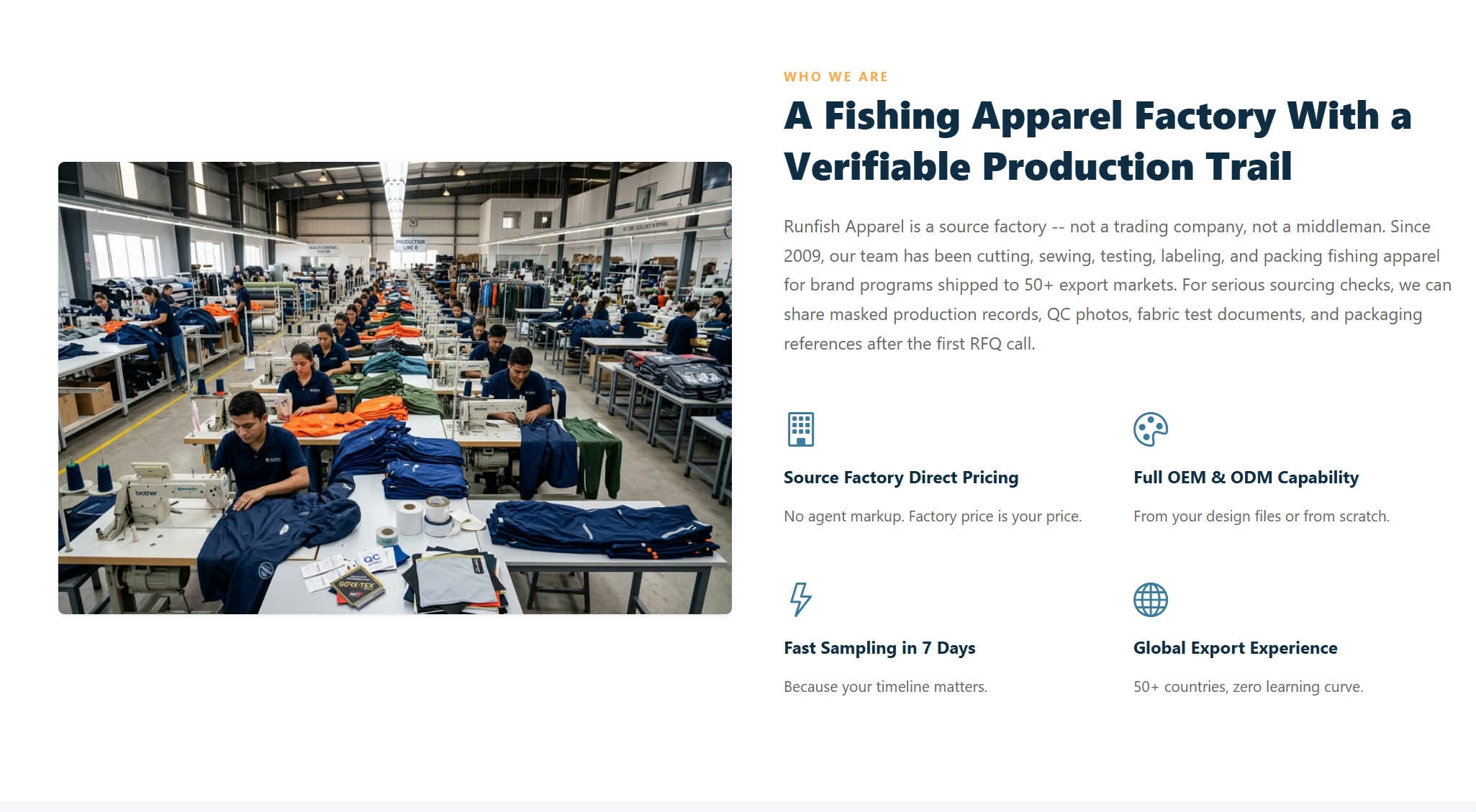
Founded in 2009 and based in Guangzhou, Runfish runs as a full-service OEM/ODM platform for fishing apparel — jackets, waders, sun shirts, accessories. The China manufacturing base is transparent. No pretense there. What sets Runfish apart from a standard factory listing is the access model. Brands that need Italian or EU-origin production for positioning get routed to vetted European partner factories. Runfish then handles the technical backbone — spec development, sampling, lab testing, QC — across the full chain.
Need "Made in EU" on the label with the story to back it up? That infrastructure matters more than geography alone.
What the Technical Standard Looks Like
Runfish builds a custom fishing jacket to premium spec with numbers that are specific and testable:
Waterproof rating : 20,000 mm hydrostatic head (ISO 811), ePTFE or PU membrane
Breathability : ≥10,000 g/m²/24h moisture vapor transmission (ISO 15496)
Seam construction : taped end-to-end, 20 mm PU tape, zero unsealed needle holes
DWR finish : C0 PFC-free, spray rating 90–100 after 20 wash cycles (AATCC 22)
UV protection : UPF 50+, ≤2% UV transmission (AATCC 183)
Zippers : YKK Aquaguard or equivalent water-resistant hardware
Abrasion resistance : ≥20,000–50,000 Martindale cycles on outer shell
Color fastness : Grade 4–5 to seawater and repeated washing (ISO 105-E02/C06)
These aren't targets to aim for. They're the pre-bulk approval thresholds. Not a single unit goes to cut until each one clears.
The Full-Chain OEM Service Model
Most fishing gear OEM suppliers hand you a price sheet and wait. Runfish builds the technical infrastructure most brands don't have in-house:
Tech Pack development — starts from a sketch and feature list, ends with a complete spec document: measurements graded XS–XXXL (±0.5–1.0 cm tolerance), Pantone colorways, stitch types, trim lists, fabric GSM targets
Pattern grading — base pattern in EU M, graded to a full size run with DXF/AI files ready for CAD cutting; marker layouts hit >80–85% fabric yield
Sample chain — proto sample → fit sample → Golden Sample locked for bulk; each stage logged with revision numbers and lab report IDs
Third-party lab testing — materials cleared before cutting; AQL 1.5–2.5 for inline QC; defect rate target ≤2.5% per shipment
EU compliance documentation — ILO ethical audit records, material traceability by lot and mill, test reports formatted for EU retail or DTC requirements
Lead times are clear and consistent. 3–4 weeks covers the Tech Pack and proto. Another 3–4 weeks handles the PP sample and lab sign-off. Bulk production at 500–3,000 units runs 60–90 days .
Who This Fits
Brands that get the most from this model share a clear profile. They're at a growth stage. They run 300–5,000 units per style per year . They have no existing EU factory relationships. And they need a positioning story — "tested to ISO standards, UPF 50+, 20,000 mm waterproof" — that holds up under scrutiny.
The MOQ stays approachable at 100–300 pcs per color per style . You don't need to warehouse 2,000 units to access the technical tier. For emerging brands working through fishing jacket bulk order economics, that's a real difference.
Reach out to Runfish: - WhatsApp / Phone: +86 177 0272 7677 - Email: sales@ runfishapparel.com (response within 24 business hours)
Come prepared with your waterproof rating target, UPF requirement, estimated order quantity, and preferred manufacturing region. That's all Runfish needs to route your brief to the right factory and get started.
#2 Italian High-End Technical Outerwear OEM Manufacturers — Arc'teryx-Level Craft for Fishing Shells
Italy has a small, elite tier of technical outerwear factories. They build at a standard most fishing brands never touch. The craft exists. The capability is real. Getting access to it means knowing where to look — and what to bring.
Two names stand out for custom fishing jacket production at this level.
CAMI S.r.l.s. (Sicily) specializes in complex double-face constructions, detailed pattern work, and precision finishing at the very top of Italian manufacturing. Their core capability — multi-layer fabric handling, luxury seam execution — carries over to taped technical shells. You just need to arrive with a complete spec. Italian Fishing Clothing Manufacturer (Martina Franca, Puglia) runs a fully in-house facility. They control materials directly and maintain a stable QA infrastructure. For tight tolerances on 3-layer shells, that vertical ownership makes a real difference.
What "Arc'teryx-Level" Means in Numbers
Matching Simms G4 Pro or Arc'teryx Alpha performance isn't a feeling. It's a spec sheet.
Waterproof rating : minimum 20,000 mm; target 28,000–30,000 mm hydrostatic head before 5x wash
Breathability (MVTR) : minimum 15,000 g/m²/24h; target >20,000 g/m²/24h
Seam tape : 13 mm micro tape for hoods and armpit gussets; 15–20 mm on body and shoulder seams; peel strength ≥ 1.0 N/cm after 5 wash cycles
Stitch density : 10–12 SPI on critical seams; seam burst strength ≥ 150 N
Laser cutting tolerance : ±1 mm on small pieces, ±2 mm on long seams
Delamination incidence : <1% after 5–10 wash/abrasion cycles
These Italian factories can hit those numbers. They won't assume them. Write every parameter into the tech pack before sampling starts. That's non-negotiable.
The Cost Reality
Italian technical fishing jacket OEM production at this spec level has a clear price structure. FOB for a fully taped 3-layer wading shell runs EUR 160–260 per unit for small-batch orders of 100–300 pieces. Labor alone takes up 30–40% of FOB . That's far higher than Eastern European or Asian production at a comparable level. Retail positioning for garments built to this standard lands at EUR/USD 550–800+ .
MOQ stays workable. CAMI and similar luxury-oriented factories accept 50–150 pcs per style per color for complex jackets. Annual capacity per technical style runs 2,000–5,000 units . This is purpose-built for flagship programs — not volume runs.
What You Must Bring
Without clear instruction, these factories default to fashion outerwear standards. To hit waterproof performance at 20,000–30,000 mm, arrive with:
Full graded digital pattern set (Lectra/Gerber/AAMA format)
Detailed seam map: tape width, tape type, SPI, and stitch type per seam
Complete BOM including fabric performance certificates (Gore, Toray, Schoeller)
Operation sequence sheet with heat-press parameters and QC checkpoints
Defined AQL threshold for seam-leak testing — AQL 1.0–1.5 is the industry standard for waterproof shells
Sampling lead time from final tech pack lock-in: 6–10 weeks . This isn't a fast-iteration model. It suits brands building one or two landmark releases per year — not monthly drops.
Before You Commit: The Pilot Protocol
Don't scale before verifying. Run a pilot lot of 30–50 pieces with full hydrostatic, rain room, and field testing. Accept factories only after they hit a ≥95–98% pass rate on waterproof tests — before moving to a 100–300 piece production run. Ask for proof of prior work on 3-layer taped shells — ski, mountaineering, sailing. Also confirm in-house or partner seam-sealing lab access with water column test capability.
The craft is here. The entry cost is precision, patience, and a complete spec document.
#3 Italian Sports & Luxury Outdoor Fashion OEM — Moncler/Stone Island Supply Chain Expertise
Moncler sends 70% of its production to façon factories — based in Italy and Eastern Europe. Stone Island pushes its dyeing, fabric R&D, and functional finishing through a tight network of Italian specialist mills. That supply chain wasn't built for fishing apparel. But it transfers well.
This tier routinely produces €600–€1,500 outerwear . These factories know fill power, membrane lamination, garment dyeing, and surface treatment at a depth most fishing jacket OEMs never reach. For brands aiming at a €900–€1,500 retail price point , this is where production capability meets the price tag.
What the Supply Chain Can Build for Fishing
Three product categories fit well within Moncler/Stone Island factory capabilities:
High-end insulated fishing parkas — 70–150D nylon outer shell, 2 or 3-layer membrane construction reaching 15,000–20,000 mm hydrostatic head , filled with 90/10 goose down at Fill Power ≥750 cuin , 150–250 g/m² insulation weight. Factory gate price: €200–€350/unit .
Softshell composite jackets — single-face knit bonded to TPU or PU membrane with fleece backing. Waterproof rating 8,000–15,000 mm , breathability 5,000–10,000 g/m²/24h . These are built for layering systems, multi-pocket setups, and accessory attachment points.
Urban-fishing crossover styles — close to Stone Island's field jacket roots: 180–260 g/m² functional cotton/nylon, DWR finish, garment-dyed or over-dyed colorways, modular detachable chest pack systems. No extreme waterproofing. Pure wearability.
The Design Collaboration Model
Italian studios in this space follow a structured development process. Budget €20,000–€60,000 for a capsule of 3–5 jacket styles. The timeline from brief to pre-production sample runs 16–28 weeks across four phases:
Brief: 2–4 weeks
Silhouette and function definition: 4–6 weeks
Color and hardware development: 4–8 weeks
Sample and lab testing: 6–10 weeks
Hardware specs matter at this level. YKK AquaGuard or VISLON waterproof zippers are standard. So are Duraflex-grade military plastic buckles, metal D-rings, and molded silicone logo patches. These aren't add-ons. They're the starting point.
The Technical Redlines
Before sampling starts, lock three things in writing:
Waterproof performance : minimum 10,000 mm for serious field use; 15,000–20,000 mm for premium positioning. Test to ISO 811 or JIS L 1092. Third-party lab reports from SGS, Bureau Veritas, or ITS are mandatory.
Seam sealing : full taped seams on all critical positions — shoulders, hood seams, armhole, front princess seams, underarm. Use 18–22 mm tape width for light shells, 22–28 mm for heavy parkas. Write heat-press parameters into the tech pack: 220–260°C, 2–3 bar pressure .
Wash durability : run destructive testing after 5–10 wash cycles at 40°C — no tape lift, no delamination, no seam failure.
The supply chain capability is there. What decides your access to it is how precise and complete your brief is.
#4 EU Marine & Safety Apparel OEM Manufacturers —
Certification changes the conversation. Add a CE mark and a verified Newton buoyancy rating to your fishing jacket, and it stops being outerwear. It becomes safety equipment. That shift opens doors in EU professional tackle retail that a standard waterproof shell cannot.
EU marine and safety fishing apparel OEM manufacturing at this tier runs on a different standard framework than technical outerwear factories. The governing spec is EN ISO 12402 . The buoyancy class you choose drives everything that follows — construction, certification pathway, retail positioning, and the type of angler you're building for.
The Buoyancy Class Framework — What It Means for OEM Decisions
Three classes matter for coastal and offshore fishing jacket production:
50N (EN ISO 12402-5) : Minimum 50 Newtons of buoyancy — about 5 kg of lift. CE-marked, built for competent swimmers fishing nearshore with rescue close by. This is your inshore and estuary product tier.
150N (ISO 12402-3/4) : ≥15 kg buoyancy. Turns an unconscious wearer face-up and clears airways. Standard spec for coastal charter boats and open-water fishing.
275N (ISO 12402-2) : ≥27.5 kg buoyancy. Built for extreme offshore conditions and heavy PPE. This is what commercial crews and serious deep-sea tournament anglers want.
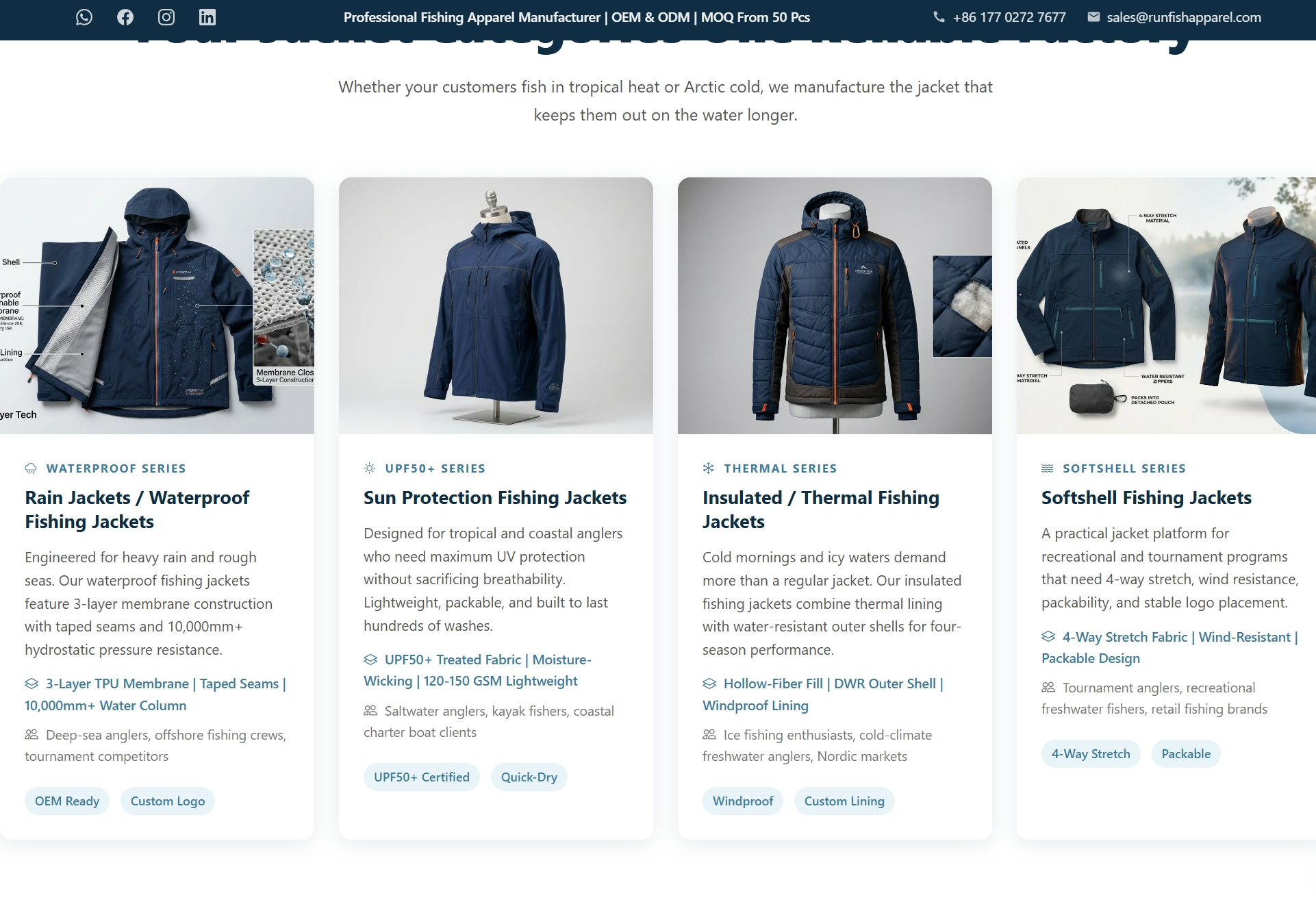
The OEM opportunity is to segment your product line across all three classes. A nearshore jacket with a CE-marked 50N buoyancy core targets shore casting, inshore jigging, and light boat fishing. Pair a heavy rain shell with an auto-inflating 150N lifejacket system , and you're covering deep-sea charter and foul-weather tournaments. Print that distinction on the hangtag. Most fishing clothing wholesale buyers in Italy and across the EU have not used this as a retail differentiation lever yet. That's an open gap.
Reference Manufacturers in This Space
Two European OEM names show what certified 50N buoyancy-integrated construction looks like in real production:
LALIZAS (distributed through SeaSafe Systems, EU-focused) produces a Work Vest 50N certified to ISO 12402-5 for users over 40 kg. The build focuses on mobility — open side panels, low bulk. That maps to the casting and deck-use demands of sport fishing. As an OEM template for a CE-marked 50N buoyancy gilet worn beneath or integrated into a fishing shell, the pattern logic is already worked out.
Traconed (Netherlands-based marine safety OEM) holds full CE/EN/ISO 12402-5 50N certification. Their design focus — free arm movement, smart geometry for rough-sea work — fits the ergonomic needs of net handling and long-session boat fishing.
Neither brand is fishing-specific. That gap is the OEM opportunity.
Construction Specs That Hold Up Offshore
Building to this standard pushes the technical checklist well past waterproofing:
Salt-spray resistance : Marine-grade hardware — 316 stainless or anti-corrosion coated alloys — tested to >240 hours salt-spray exposure with no visible degradation
UV-stable seams : Bonded polyester yarns rated ≥5 on the blue-wool scale , holding structural integrity past 500 hours UV exposure — critical for buoyancy foam and seam certification retention
Reflective trim : SOLAS-approved retro-reflective tape at ≥7 cd/lux/m² , placed on shoulders, hood, and chest for 360° visibility from standard fishing postures
Abrasion resistance on reinforced shoulder and chest panels: ≥50,000 Martindale rubs to handle wave impact and rope contact
Ergonomic geometry : Shorter front panels for rod butt clearance, high-cut open sides for line and net clearance, reinforced shoulder construction
The EU Retail Positioning Playbook
Brands targeting EU professional fishing retailers and tackle chains need to state the certification story outright — not hint at it. Put a simple buoyancy class chart on hangtags and POS materials:
Class | Scenario | CE Standard |
|---|---|---|
50N | Shore/inshore, competent swimmer | EN ISO 12402-5 |
150N | Coastal/charter boats, mixed conditions | ISO 12402-3/4 |
275N | Extreme offshore, heavy gear | ISO 12402-2 |
Lead with tested Newton values. Drop vague language like "floating jacket." Show third-party lab reports from SGS, Bureau Veritas, or ITS. For tournament and premium-tier brands, the dual-cert approach — impact protection plus verified buoyancy, CE-marked to EN ISO 12402-5 — is the same credibility model that established tow-sports vest brands used to build significant retail price premiums.
The certification infrastructure exists and is ready to use. What most private label fishing apparel brands lack is a supplier who understands both the marine safety standard and the angling use case. You need a partner who can build a product that satisfies both at once — and that's where the real market gap sits.
#5 Premium Global Fishing Apparel OEM with EU Production Benchmarking — Performance Reference Standard
Before you sign anything with an Italian factory, you need a number to argue from.
That number is the global performance envelope. It's what the world's best technical fishing jacket OEM suppliers produce — measured, tested, and documented. Without it, every factory conversation turns into a negotiation where you have no idea what "good" looks like.
Here's what good looks like.
The Performance Benchmark Band
Waterproof rating : 10,000–30,000 mm hydrostatic head. Premium marine shells land at 20,000–28,000 mm. Top-tier membranes hold that rating past 120 washes.
Breathability : 10,000–30,000 g/m²/24h. All-day wear needs a minimum of 15,000.
UV protection : UPF 50+, blocking ≥98% UVA/UVB across 500+ hours of sustained exposure.
Abrasion resistance : ≥10,000 cycles on reinforced zones before surface failure.
Seam construction : 100% taped, 18–22 mm tape width, zero leakage after 3–5 hours at 5,000 mm static head.
Three Production Tiers — Pick One Before You Source
Tier | Waterproof | Breathability | Target Retail |
|---|---|---|---|
Flagship (A) | ≥25,000–28,000 mm | ≥20,000 g/m²/24h | EUR 320–480+ |
Premium Core (B) | 15,000–20,000 mm | 10,000–15,000 g/m²/24h | EUR 250–320 |
Advanced Entry (C) | 10,000–15,000 mm | Baseline | EUR 220–250 |
Italy production earns its place at Tier B and above . Below EUR 220 retail? Asia OEM at 10,000–15,000 mm is the clear call. Above USD 250 with a European craftsmanship story? Italy's cost premium runs +USD 40–100 per unit over comparable Asian production. At 10,000 units per year, that gap closes within 1–2 seasons .
That's not a feeling. That's the math.
Italy vs Asia: How to Decide Where to Manufacture Your Premium Fishing Jacket in 2026
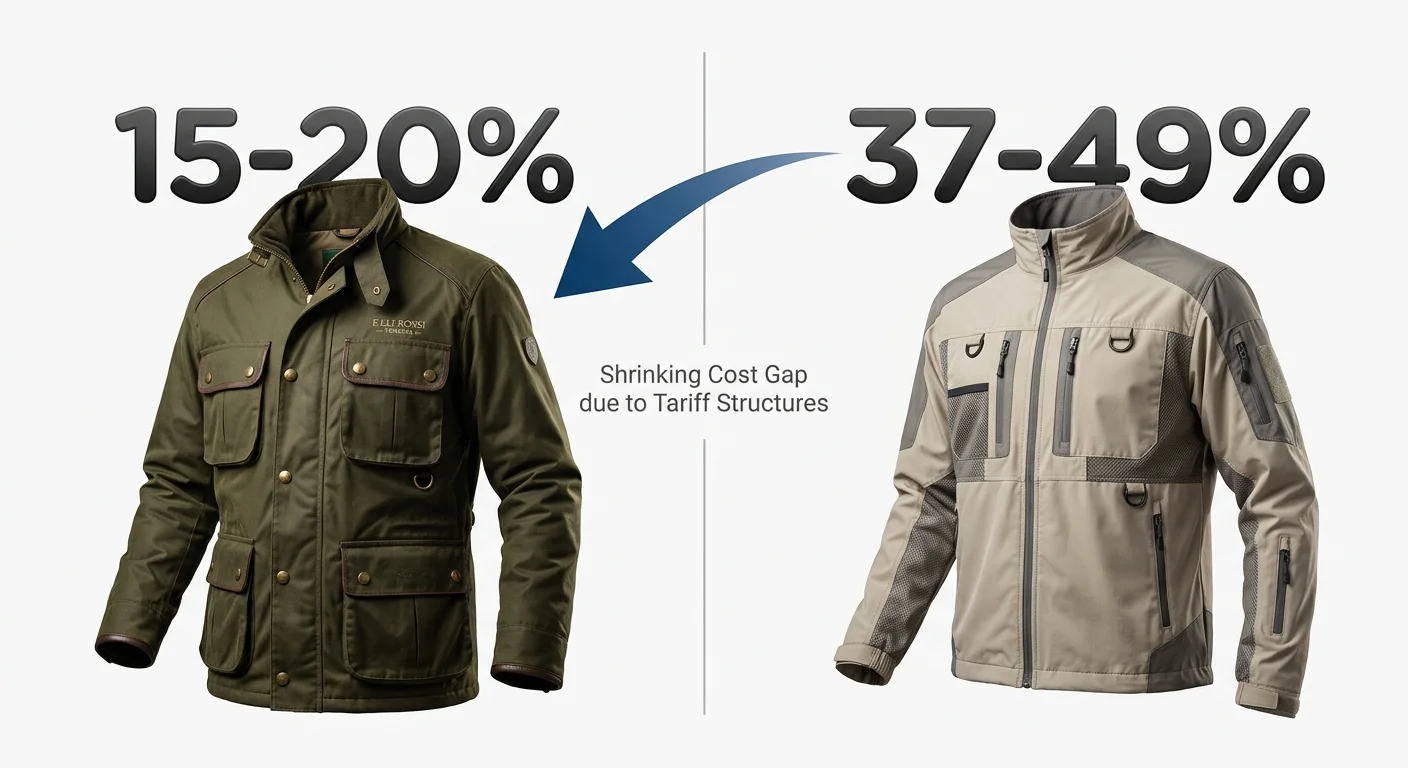
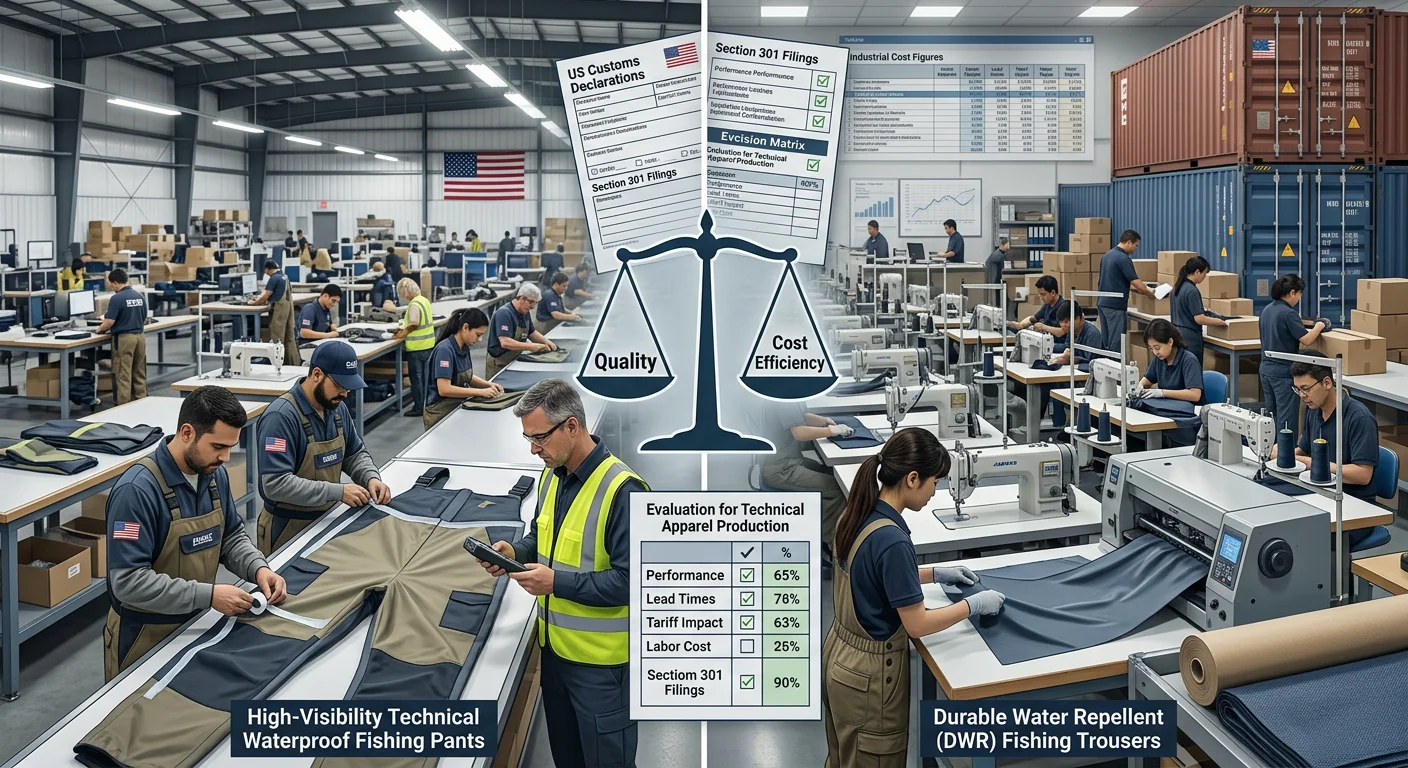
The math on this decision changed in 2026. Not because Italian craftsmanship got better — it was already exceptional. Asian tariffs got worse. That's what shifted everything.
Here's the number that rewrote the sourcing playbook: 37–49% import duty on outerwear from Bangladesh, Vietnam, and Cambodia into the US. Italy and the EU? 15–20% . That's a 20–30 percentage point tariff gap on invoice value. For a premium fishing shell with a high FOB, that gap doesn't just narrow the cost advantage of Asian production. It starts to erase it.
Run the actual numbers. An Italian-made jacket at USD 180 ex-factory lands at USD 212 after 18% duty. An Asian equivalent at USD 60 FOB lands at USD 85 after a 42% mid-band tariff. Asia is still cheaper per unit. But the historical cost gap has shrunk by 25–35%. At higher FOB price points, it shrinks further.
That's not a reason to manufacture everything in Italy. It's a reason to be deliberate about where each SKU gets made.
The Decision Matrix: Brand Positioning × Target Market
Where you source isn't a values question. It's a positioning and margin question. Here's how to cut it clearly.
Luxury tier (USD 900–1,500 retail) targeting Europe:
Italy is the clear answer. "Made in Italy" under Italian Law 55/2010 works as both a legal and commercial luxury signal. EU distribution avoids the Asian tariff issue. Specialist outerwear districts — Prato, Veneto — handle 100–500 unit batches with the finish quality to justify wholesale at USD 300+.
Luxury or high-end tier targeting North America:
Italy becomes the flagship strategy, not the only one. Paying 37–49% duty on a USD 200+ Asian FOB jacket destroys your margin story on premium SKUs. Italy at 15–20% duty, paired with a strong craftsmanship narrative, covers your hero styles. Let Asia handle volume-driven shells at USD 350–550 retail where cost still matters.
Pro-technical tier (USD 350–700 retail) in any market:
This is where the hybrid model earns its place. Asia's technical capability — seam-sealed shells, 3-layer laminates, synthetic insulation builds — is now competitive at this price band. Bangladesh vertical lines and China synthetic fabrication are world-class at this level. The premium story doesn't move product here. Performance data does.
Mass-competitive (USD 150–350 retail):
Asia, full stop. The market at this price point doesn't reward "Made in Italy." It rewards landed cost efficiency and fast iteration cycles.
Where Italy's Advantage Is Real — and Where It Isn't
Italy earns its production premium in a specific zone:
Wholesale ≥ USD 300, retail ≥ USD 700 , where luxury positioning is the main commercial lever
Small-to-medium runs of 100–300 units per style , where Italian district factories are well set up and comfortable
Material-driven storytelling : Italian wool linings, Biella fabrics, leather detailing, Como-woven trims — these aren't just materials, they're retail narrative
EU compliance : ESPR, OEKO-TEX, GOTS certification paths are cleaner with production inside the EU
Asia leads everywhere else. Complex taped seams, multi-layer synthetic shells, high-volume runs at 1,000+ units per SKU — China and Bangladesh handle all of it at a fraction of the labor cost. Lead times support frequent seasonal updates too.
The Hybrid Structure Most Serious Brands Will Run in 2026
A fishing apparel brand with real distribution goals doesn't need to pick one side. It needs a portfolio split:
Italy flagship line : 2–4 SKUs — a guide shell, a winter parka, a heritage wading jacket. 100–400 units per season . These are your PR assets, your key-retailer placements, your brand story in product form.
Asia core line : 6–12 SKUs — standard shells, insulated jackets, bibs. 1,000–3,000 units per SKU . These are your volume, your cash flow, your DTC engine.
The math on this split is surprising but important. Take a 20,000-unit annual production scenario — 3,000 Italian units across three flagship SKUs, 17,000 Asian units across eight core SKUs. The Italy line may represent 35–45% of total revenue at just 15% of total volume. Higher price points shift the unit economics in Italy's favor.
Execution sequence matters too. Calculate per-SKU landed cost before committing to any factory. That means FOB plus tariff — Italy into EU and US premium retail, Asia into US DTC and APAC distributors. Send your Italian production to EU retail and US flagship accounts. The 15–20% duty and the "Made in Italy" story work together there. Send Asian production to volume DTC and APAC wholesale, where neither factor applies.
One last point: Italy's production districts handle 100–300 pcs per color per style with sampling lead times of 6–10 weeks . Asian factories need 12–16 weeks but take on larger batch buys and fabric consolidation that push unit costs down at scale. Plan your calendar around this. These are two different production rhythms. They need two separate operational tracks running at the same time.
FAQ: Premium Fishing Jacket OEM Manufacturing in Italy
Ten questions. Answered straight. No filler.
Q1: What's the MOQ for Italian fishing jacket OEM?
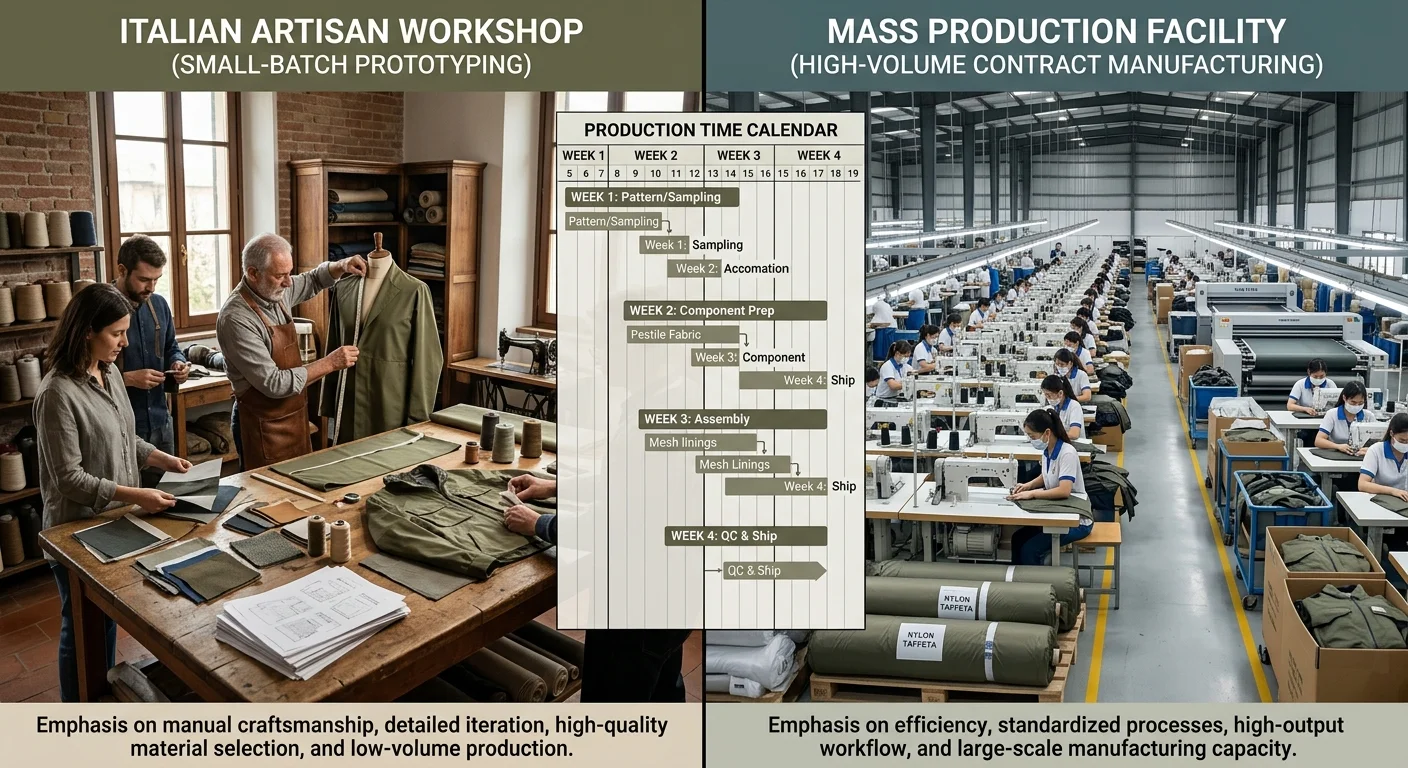
It depends on the factory tier. Artisan workshops focused on luxury technical construction accept 5–10 pieces per style — that's a real number, not a rumor. Industrial sportswear manufacturers work at 100–300 pcs per style . Most global OEM benchmarks sit at 500–1,000 units . Italy's specialist districts are comfortable with smaller batches, though. That's part of what you're paying for.
Q2: How long does production take?
Expect 30–60 days after sample approval for bulk orders. Add 7–15 days for pattern work and sampling upfront. Complex builds — taped seams, multi-layer membranes, custom hardware — push toward the 60–90 day range. Budget 3–10 days on the back end for QC and packing. Total project timeline from brief to shipment: 10–16 weeks .
Q3: Is the cost premium worth it?
The math is clear. Italian OEM runs 2–3x Asian factory pricing on comparable specs. Asian luxury-grade shells start around USD 25–30 per unit . Italian equivalents cost more — but in premium markets, retail markup potential sits at 3–5x factory price . That changes the margin story. Plus, lower return rates and stronger brand positioning build on that advantage over time.
Q4: How do you verify an Italian OEM partner before committing?
Five steps. No shortcuts.
Confirm legal registration — Italian chamber of commerce, active VAT number, 10+ years in outerwear manufacturing
Request a technical portfolio showing rain jackets, sailing shells, or existing fishing outerwear. Check "Made in Italy" labeling on those products
Ask for ISO 9001 certification and social audit reports (SMETA or BSCI)
Get references from current EU or US outdoor apparel clients
Run a remote or onsite factory audit — check for seam-taping machines, fabric inspection stations, and a clear final QC process
Q5: What certifications matter?
Minimum threshold for premium fishing jacket OEM in Italy:
ISO 9001 — quality management baseline
bluesign-approved fabric suppliers — environmental compliance on waterproof membranes
REACH compliance — mandatory for EU market distribution
EN/ASTM water resistance standards — documented waterproof ratings of 5,000–10,000 mm minimum
Tournament-grade or marine safety lines need extra CE certification under EN ISO 12402.
Q6: Can I get private label production in Italy?
Yes — and Italian factories do it well. You get custom labels, embroidered logos, rubber badges, laser-cut brand marks, and EU-compliant care labels. The full private label package. Luxury workshops start at 5–10 pcs MOQ . Technical sports jacket lines start at 100+ pcs . Both tiers carry "Made in Italy" labeling — which is the whole point.
Q7: What specs should I demand from an Italian OEM partner?
Skip vague quality claims. Negotiate against hard numbers:
Waterproof rating : minimum 10,000 mm water column for serious field use. Premium positioning needs 20,000–28,000 mm
Breathability : minimum 5,000 g/m²/24h . All-day wear demands 15,000+
Fabric shell weight : 120–180 gsm for lightweight technical builds
Seam construction : taped seams throughout, waterproof zippers (YKK AquaGuard or equal), reinforced stress points
Size range : S through 3XL with adjustable hoods and cuffs
Q8: How do I start an OEM project in Italy from zero?
Six steps. In order.
Write a complete tech pack — waterproof rating, breathability target, pocket layout, hood type, fabric GSM, full size run
Shortlist Italian manufacturers with proven outerwear experience and export history
Send the tech pack with your target MOQ ( 50–200 pcs per color ). Request quotes with lead times
Order a prototype. Run waterproof and durability tests. Adjust once if needed
Lock down MOQ, price, lead time ( 30–60 days post-sample ), and defect allowance thresholds — all in writing
Approve the pre-production sample, place the bulk PO, and track against set milestones — cutting, sewing, seam taping, final inspection
Standard payment terms for new clients: 30% deposit, 70% before shipment . Many Italian OEMs back their performance outerwear with 1–2 year durability assurances on seams and zippers. Confirm this before production starts — not after.
Conclusion
Italy doesn't just make fishing jackets — it sets the standard every other manufacturer tries to meet.
Starting a premium angling brand from scratch? Repositioning an existing line for higher margins? The right Italian outdoor apparel manufacturing partner makes a real difference. Craft, certification, material sourcing, technical execution — these aren't marketing talking points. Coming from Italy's supply chain, they're proof points your customers feel the moment they touch the product.
The five fishing apparel manufacturers in this guide are the strongest entry points for 2026. But a list only takes you so far.
Your next move: reach out to Runfish Apparel and let's map out what custom fishing jacket production looks like for your brand — timeline, MOQ, fabric spec, the whole picture.
Premium doesn't happen by accident. It happens when you choose the right partner on purpose.